Notes on remediation-first infrastructure
Engineering deep-dives, product updates, and field notes from teams shifting off reactive observability.
What You Won’t Hear at ObservabilityCON
The stage shows an AI agent on top of your data cloud. The people who carry the pager, when no vendor is in the room, describe something else: an agent that goes to the data, a backend that becomes storage, and a bill that stops charging for a reader who has left.
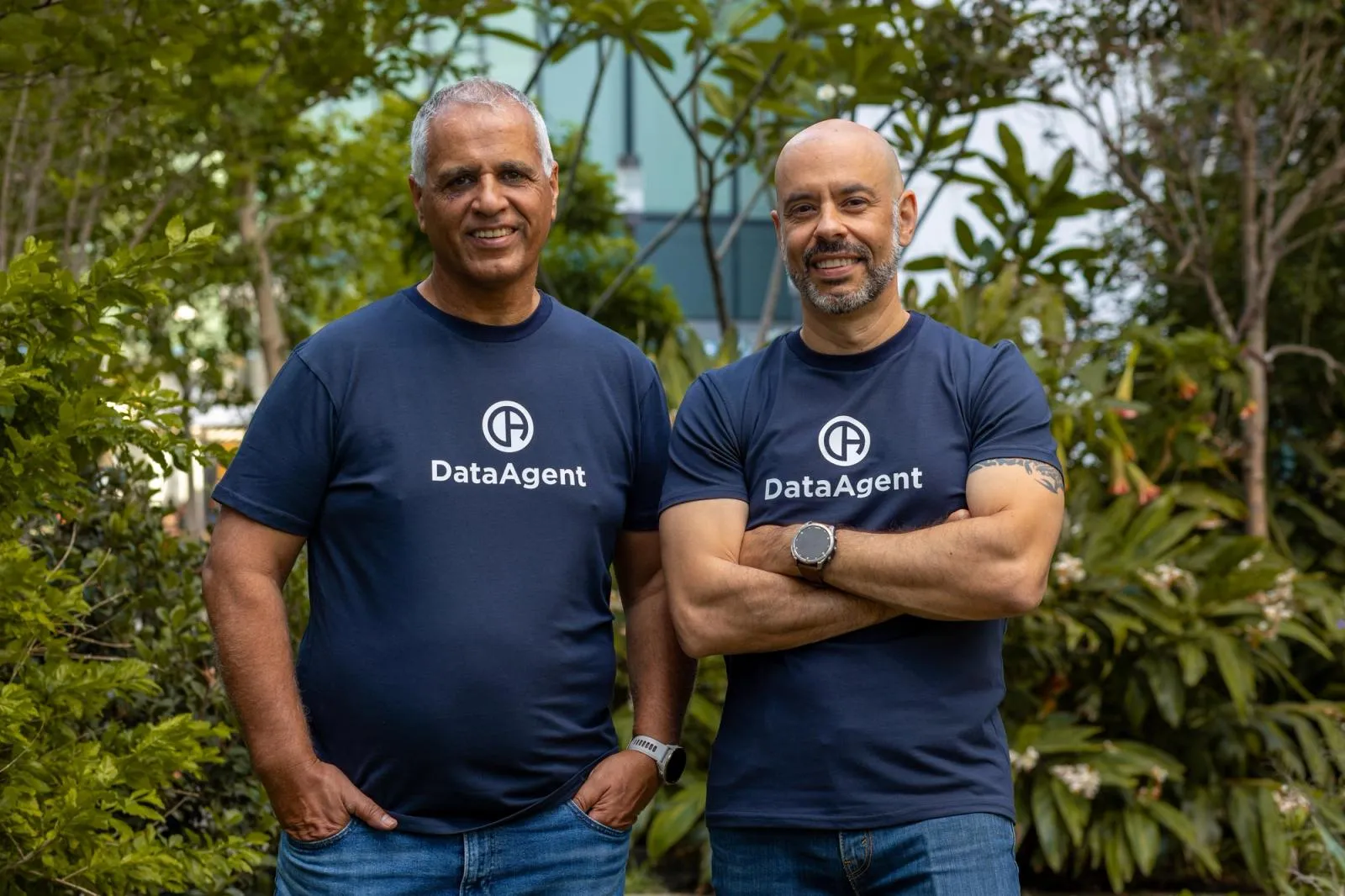 Nati ShalomCo-founder & CTO
 Engineering14 min
Who Pays for the Dashboard?
We priced one Kubernetes-on-AWS workload across observability backends. Copying telemetry into a SaaS platform costs 5–9× the open-source floor, and an autonomous agent uses none of what the premium buys. Build the substrate cheap; fund the loop.
Nati Shalom • Oct 11, 2026 Engineering11 min
Is AI Making Your SRE Team Better? Ask the Scale, Not the Mirror
AI makes engineers faster at producing changes and makes production less stable. Which effect wins depends on your platform. Four production numbers tell you whether AI is actually making your SRE team better.
Shahar Harap • Oct 11, 2026 Product7 min
They Told Me the Market Is Saturated. That's Exactly Why I Co-Founded DataAgent.
Everyone agrees observability costs are out of control, and almost nobody believes there is a fix. That gap is why I joined DataAgent as co-founder and CTO.
Nati Shalom • Oct 5, 2026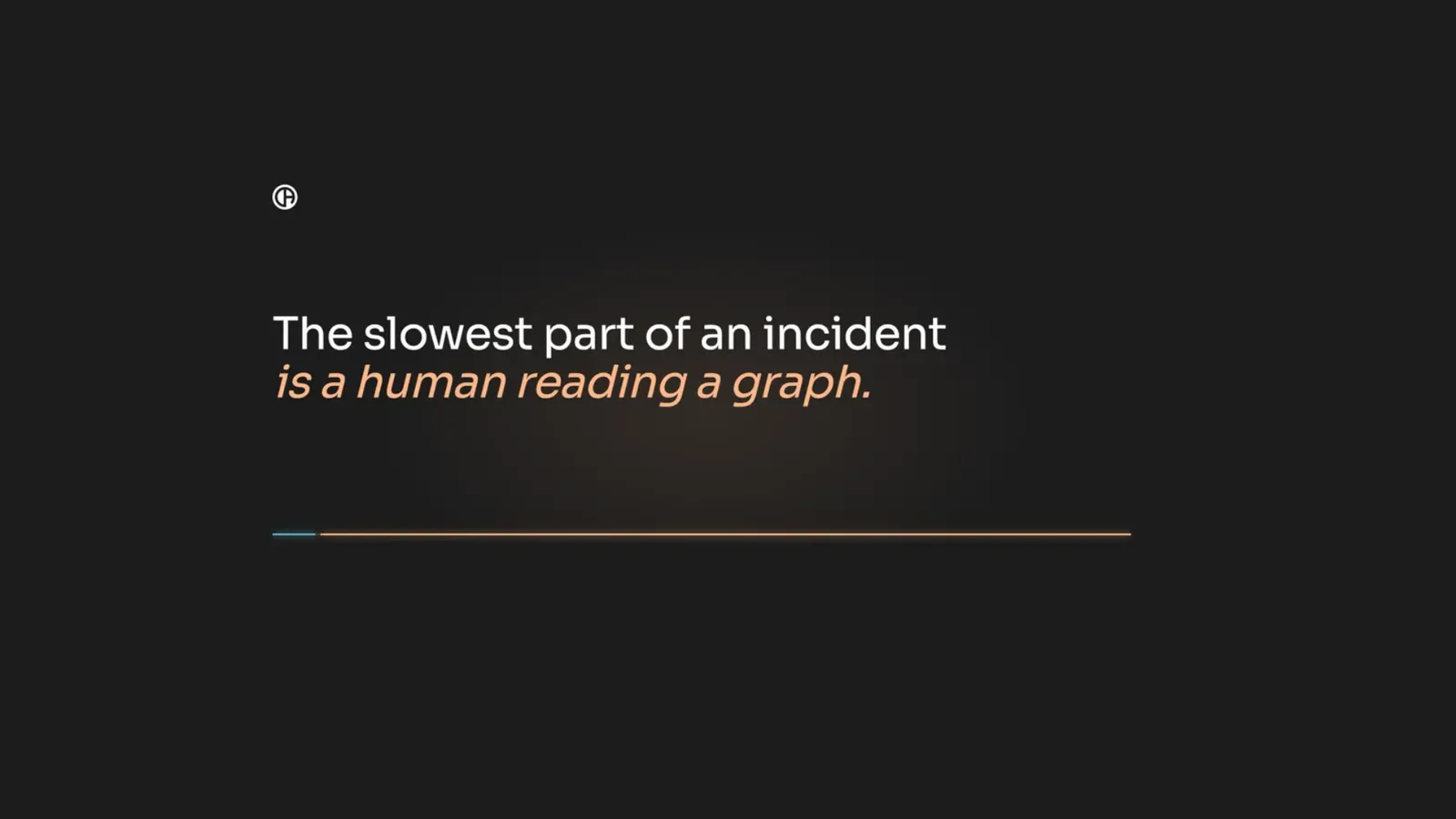 Engineering8 min
How to Reduce MTTR: The Slowest Part of Your Incident Is a Human Reading a Graph
Detection takes seconds. Everything after it is a person reading graphs, forming a theory, acting and verifying. That is where MTTR lives, and why remediation-first systems that detect, diagnose, act and verify bring it down further than another dashboard or assistant.
Nati Shalom • Oct 5, 2026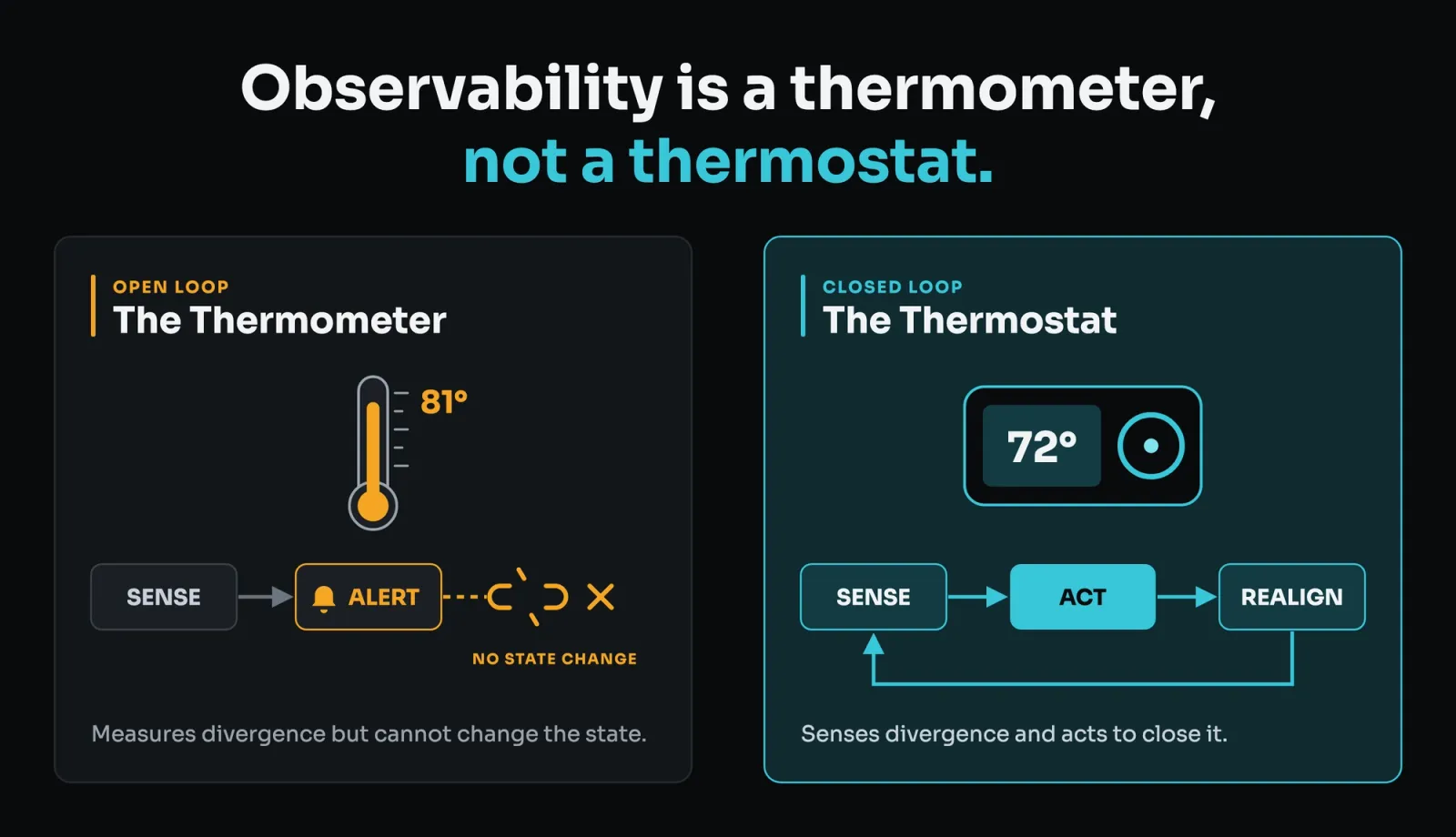 Engineering10 min
AI Is Breaking Production, and Observability Can't Fix It
AI made us faster at producing plausible code, not at keeping production healthy. More observability gives you a better thermometer; a smarter assistant gives you more memos to verify. Neither closes the loop. A remediation-first Digital Immune System does.
Nati Shalom • Sep 27, 2026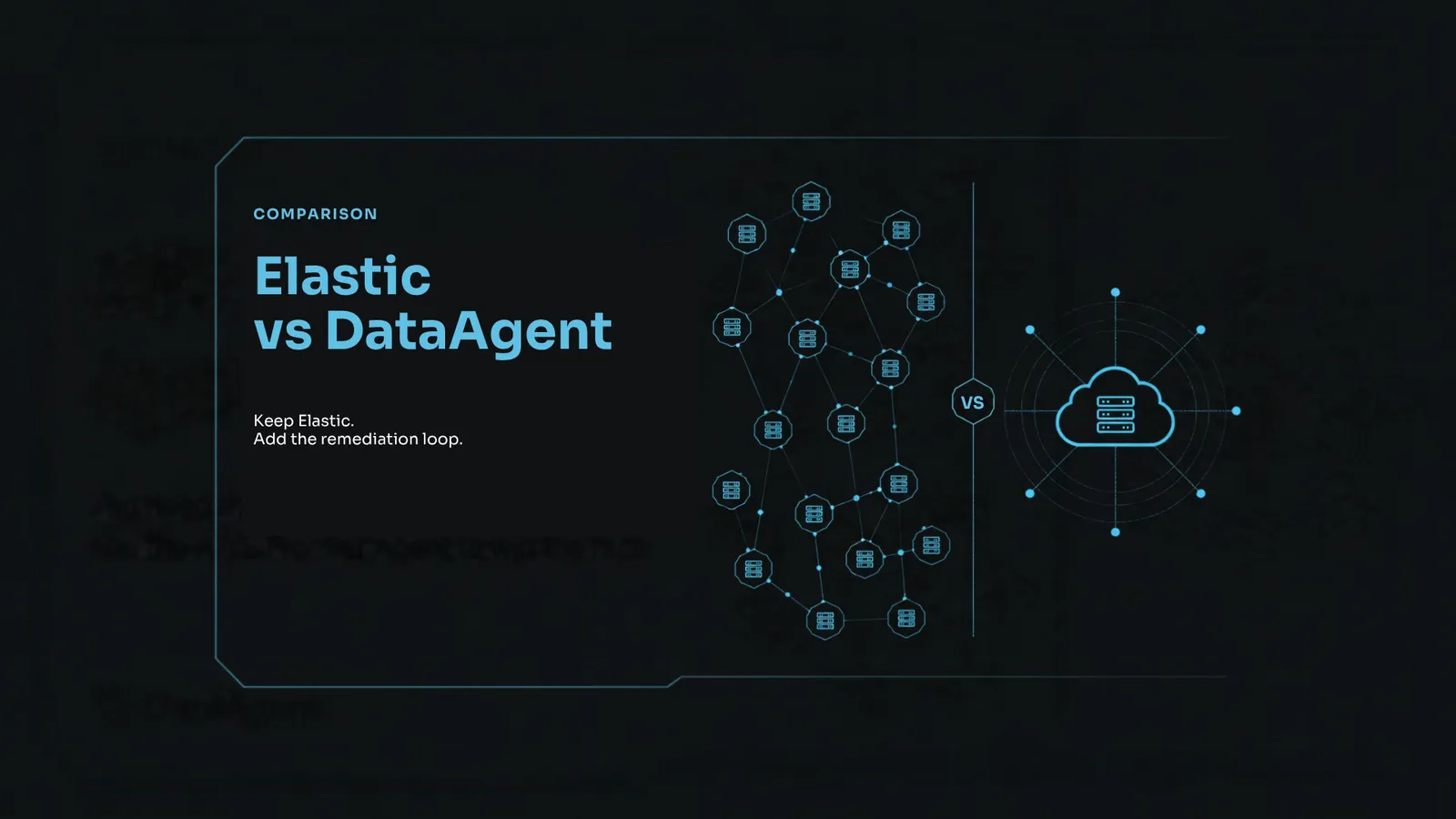 Product11 min
DataAgent vs. Elastic: Full Comparison
Keep Elastic for search and security. See how DataAgent adds autonomous K8s and cloud remediation on top, and helps cut your Elasticsearch storage bill.
DataAgent • Sep 1, 2026 Product12 min
DataAgent vs. Datadog: From Finding the Problem to Fixing It
Running Datadog? See how DataAgent adds autonomous remediation alongside it, and how its read-in-place model compares to Datadog's per-host billing.
DataAgent • Sep 1, 2026 Product13 min
DataAgent vs. Grafana Cloud: Where Observability Stops and Remediation Begins
See where Grafana Cloud's observability stops and where DataAgent's autonomous remediation picks up, with a fault-by-fault breakdown.
DataAgent • Sep 1, 2026 Engineering13 min
Left of Boom, Right of Boom: Prevention and Remediation Are One Loop
The industry split reliability into two disciplines: prevent it, and survive it. Both ask the same causal question — which change produces which failure — and neither can answer it alone. Why the postmortem is a broken transfer mechanism.
Nati Shalom • Aug 26, 2026 Engineering14 min
The Great Inversion: AI Writes the Code, Production Pays the Review Bill
Generation got two orders of magnitude cheaper; human verification capacity did not move. GitClear's 2026 data shows duplication at its highest recorded level while refactoring falls — and the defects that reach production are structural, not syntactic.
Nati Shalom • Aug 26, 2026 Engineering12 min
Precision vs. Recall: Why Observability Costs So Much
Observability bills are shaped by one unstated assumption: a human might need to scroll back. That is collection optimized for recall. An agent present at the moment of the fault optimizes for precision — and precision scales with your incident rate, not your estate.
Nati Shalom • Aug 26, 2026 Engineering11 min
What Is Remediation in Production Systems? Mitigation, Remediation and Resolution, Defined
Remediation means correcting the condition that caused a fault — not reducing its impact, not restoring service, not closing the ticket. The difference between mitigation, remediation, resolution and recovery, and what makes an action safe to automate.
Nati Shalom • Aug 26, 2026 Engineering13 min
Autonomy Is a Body Problem, Not a Data Problem
In 2026 the biggest observability vendors conceded that fixing, not watching, is the point. But an agent bolted onto a billed-by-ingestion data lake inherits the lake's ceiling. Autonomy is a harness problem: tools, state, guardrails, and verification. Not a data problem.
Nati Shalom • Aug 24, 2026 Engineering7 min
A Year of DevOps With an AI Agent
A year of running production infrastructure with an AI agent in the loop — EKS, Terraform, and the CI that holds it together. Not a 10x story: what actually changed was when my mistakes surfaced, what the work cost, and how much of it I had to remember myself.
Shahar Harap • Aug 24, 2026 Product3 min
It's time to let the dog out
For decades, observability has worked like a watchdog: it barks when something's wrong and waits for you to come running. That stopped making sense the moment we could build a system that acts on its own. Why I named the company DataAgent.
Ishay Yaari • Aug 24, 2026