DataAgent vs. Datadog: From Finding the Problem to Fixing It
Running Datadog? See how DataAgent adds autonomous remediation alongside it, and how its read-in-place model compares to Datadog's per-host billing.
 DataAgentCompany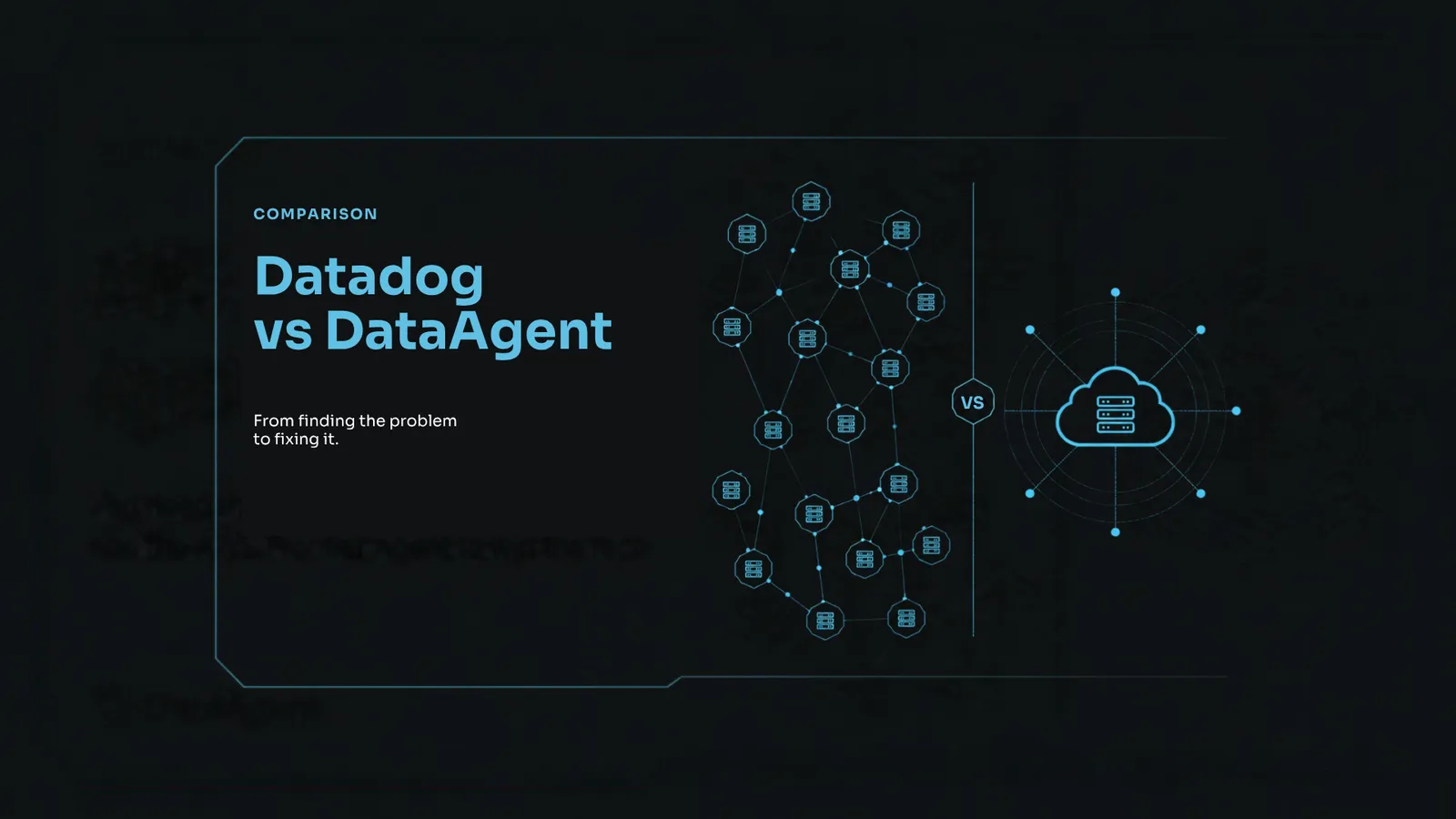
Quick answer: Datadog is a deep, mature observability platform, and Bits AI now investigates incidents and, in Preview, can run remediation actions within guardrails a team defines. DataAgent, an autonomous SRE platform, is remediation-first: it reads AWS and Kubernetes control-plane state in place and closes the loop with a verified fix, gated by autonomy each fault class has earned by proof, which customers enable after a read-only deployment shows them a fault-coverage report. It runs alongside Datadog, no rip-and-replace. It also helps with the cost side: Datadog meters a dozen-plus products separately and uses high-water-mark billing that penalizes short-term scaling, and a read-in-place agent reduces the volume flowing into those meters.
Datadog earns its scale honestly. It's a genuinely deep, polished product, its APM and UI are best-in-class, and it's expanding fast: Datadog launched more than 100 capabilities at DASH 2026, many of them for Bits AI. This isn't a case that Datadog is a bad product. It's a case that its remediation maturity and its pricing model are where teams run into a ceiling, and where DataAgent starts, alongside Datadog, not instead of it.
MTTR Reduction
Diagnosis speed and fix speed both roll up into the one number leadership actually tracks, mean time to resolution, and a platform can improve one without touching the other.
How Datadog handles it
Watchdog and Bits AI SRE genuinely cut diagnosis time: Bits AI SRE is built to investigate an alert and surface a root cause in minutes rather than hours. That's real value on the diagnosis half of MTTR. The fix half still depends on a person executing the suggested action, or approving a one-click action in Preview, for anything outside the narrower set of fault types Bits Infrastructure Operations explicitly covers under a team-defined guardrail.
How DataAgent handles it
DataAgent decouples stabilization from full root-cause analysis. A fast, deterministic circuit-breaker fires in seconds to stabilize a fault class while the deeper SURGE root-cause analysis keeps running in the background, so time-to-mitigate isn't waiting on a complete diagnosis or a person picking up a page. This is the remediation-first approach: fix first, investigate later.
Remediation & Root Cause Depth
The real question isn't whether a platform can find a problem, most can. It's whether it finishes the job, and how much of that is earned trust versus a rule your team wrote by hand.
How Datadog handles it
- Bits Investigation, Bits Detection, Bits Infrastructure Operations, and Bits Remediation are real, named products, not vague roadmap items.
- Bits Infrastructure Operations targets issues like disk saturation, CrashLoopBackOff and OOMKilled errors in Kubernetes, Lambda concurrency limits, expiring TLS certificates, and memory pressure on ECS, before they escalate.
- One-click remediation actions and Kubernetes actions are currently in Preview, per Datadog's own documentation.
- Bits acts within guardrails your team defines: autonomously resolving what's explicitly permitted, and surfacing the rest for human approval.
- That's a real gating model, built from guardrails a team defines, and Datadog says Bits learns from approved changes to expand what it handles alone. It's still not autonomy that a fault class has earned by proving itself in a sandbox first.
How DataAgent handles it
- Runs a closed loop: PULSE detects, TIDE enriches with topology and drift evidence, SURGE produces the root-cause chain-of-thought.
- STEER gates the proposed fix against trust thresholds earned per fault class (the Fault Ladder).
- RAPS executes the verified playbook, and WAKE learns from the confirmed outcome.
- A fault class only acts autonomously after it has been proven, through sandbox fault injection, to detect, diagnose, and recover correctly, and after the customer enables autonomous action for it.
- Anything unproven routes to a human instead of guessing.
Copilot vs. Autonomous Remediation
Separate from whether a fix is possible at all is the day-to-day interaction model: does someone have to be reading a chat response and clicking approve, or does the system act on its own for what it's already proven it can handle.
How Datadog handles it
Bits AI is, at its core, a platform-wide copilot: you query it in natural language. Bits Remediation lets you trigger triage actions from inside that chat, sending Slack or Teams messages, opening a Jira ticket, paging an engineer, and, in Preview, clicking Run on a suggested one-click action rather than copying a command into your own CLI. Bits Infrastructure Operations goes further: within the guardrails a team defines, it can resolve issues automatically when explicitly permitted, and surface the rest for approval. That's real progress toward autonomy, but the permission starts from guardrails a team defines by resource, environment, and action type, not from a fault class proving itself in a sandbox first.
How DataAgent handles it
There's no chat window sitting between detection and the fix by default. STEER gates action against trust thresholds earned per fault class, so once a class has proven itself through sandbox fault injection and the customer has enabled autonomous action for it, DataAgent acts on it directly in production without waiting for someone to read a chat response and approve it, and it still routes anything unproven to a human rather than guessing.
Pricing & Cost Model
This is the dimension that sends most teams looking for ways to cut their Datadog bill in the first place, so it's worth being specific about the mechanics, not just the sentiment.
How Datadog handles it
Datadog isn't one product with one meter, it's a dozen-plus separately priced products, each billed on its own usage dimension, simultaneously. As of 2026, list pricing runs roughly: Infrastructure Monitoring around $15 to $23/host/month, APM around $31 to $40/host/month, Log Management at about $0.10/GB ingested plus roughly $1.70/million events indexed, and custom metrics around $5 per 100 indexed metrics beyond the included allotment (Pro plan). Database Monitoring and RUM each carry their own separate rate on top of that.
Two mechanics make the bill hard to predict rather than just expensive:
- High-water-mark billing. Datadog measures active hosts hourly and bills the whole month against roughly the 99th-percentile hour. A team running 50 hosts that scales to 200 for a five-day campaign can see a bill jump from around $1,550 to about $6,200 for that month, even though the spike lasted days, not weeks.
- Non-linear scaling with headcount. A 10-engineer team might run 15 services on 30 hosts. As a team grows, services, containers, and custom metrics compound together, so the bill tends to grow faster than the org does.
The practical result shows up in public writeups and forums: one public breakdown models a 100-engineer team (150 infrastructure hosts, 100 APM hosts) at about $26,300/month, and custom metrics alone frequently make up 30 to 50% of the total bill. It's not hidden pricing; the rate card is public. It's that a dozen-plus independently metered dimensions compound in ways that are genuinely hard to model in advance.
How DataAgent handles it
DataAgent's agents run inside your clusters and read AWS and Kubernetes control-plane state directly, at the source, instead of requiring you to ship it into a central store. By processing data inside your environment and focusing on essential Golden Metrics, DataAgent is potentially reducing observability costs by up to 90%, and because it's AWS-native, it doesn't add a forwarding tax on top of what you already pay AWS for the same data. A read-only deployment maps the telemetry your existing tools collect, including overlap and redundancy, into a cost-savings analysis before any commitment.
Architecture
Cost and capability both trace back to the same root decision: does the platform need your data centralized in its own store before it can act on it, and how much gets collected and retained "just in case" versus fetched only when it's actually needed.
How Datadog handles it
Datadog's business model is priced on ingestion: you pay to send data in, and pay again (via indexing, retention, and custom-metric fees) to keep it queryable. Because a human or an AI judge might need to query any of it later, the default posture is broad collection, which is also the direct cause of the pricing mechanics above. That means any cost optimization Datadog ships has a structural ceiling, shrinking what you send them shrinks what they bill you, so the incentive to help you reduce ingestion only goes so far.
How DataAgent handles it
DataAgent's read-in-place model never requires you to centralize data into a vendor-owned store before analysis can run. The agent reads Kubernetes and AWS control-plane state where it already lives, and raises fidelity to full resolution only where and when a fault is actually unfolding, rather than retaining everything broadly in advance in case a query needs it. That's also why DataAgent's cost model isn't built around discouraging you from collecting more.
How Each Platform Learns and Improves
As remediation becomes table stakes across the industry, how a platform verifies a fix actually worked, and gets better from it, matters as much as whether it can attempt one at all.
How Datadog handles it
In June 2026, Datadog acquired Adaptive ML, which joined Datadog AI Research. Adaptive ML's platform trains models on production signals, synthetic data, and custom AI judges, models that score another model's output to produce a training reward. It's a real, serious investment. The structural limit is the reward itself: a model judging another model's output is a learned signal, which means it can drift or be gamed, and it trains against production data, a passive record you can't reset or rerun to try a different action.
How DataAgent handles it
DataAgent's fault-class catalog is extended and validated through WEAVE, which injects real faults into a resettable sandbox with a known correct class, root cause, and fix already attached. Every training signal is a checkable ground truth rather than one model's opinion of another's output, the same reinforcement-learning-with-verifiable-rewards approach that made RL reliable for math and code. Because it's a live, resettable environment, the loop is: inject, act, observe, revert, repeat, not a one-shot read of whatever happened to occur in production.
Cloud & Cross-Stack Reach
Whether a platform can only reason over what you've paid to ingest, or can read a broader system natively, shapes both cost and RCA depth.
How Datadog handles it
Bits AI reasons primarily over telemetry already ingested into Datadog: logs, metrics, traces, RUM, and profiling. Datadog does support pulling in AWS CloudTrail logs through its log integration, useful for security and compliance investigation, but that's a separately ingested, separately billed log stream, not something the autonomous remediation loop reasons over natively by default.
How DataAgent handles it
DataAgent reads AWS control-plane data, including CloudTrail and IAM, and the Kubernetes audit log directly, as part of the same loop that diagnoses and fixes a fault, not a separately ingested and billed side channel. That's what lets it attribute causes like a silently revoked IAM permission or an RBAC denial back to the exact change and actor, without asking you to pay to ship that data anywhere first.
Alert Noise & Incident Grouping
A platform that surfaces every anomaly as its own alert creates a different kind of toil: a dozen pages for the same root cause instead of one page that says what actually broke.
How Datadog handles it
Watchdog is a genuine strength here, and one of Datadog's most mature AI features: it auto-detects anomalies across infrastructure, APM, and logs without any configuration or setup. This has been in production and improving since 2018 and needs no setup to start providing value. Where it's still team-driven is anything outside Watchdog's own automatic detection: custom alert rules, notification policies, and routing are configured and tuned by your team, the same as most observability platforms.
How DataAgent handles it
Incidents are grouped by topology proximity, not just metric correlation. A database issue and the five downstream services it's affecting collapse into one incident automatically, because the grouping is based on the actual dependency graph TIDE maintains, not a pattern learned from historical anomaly correlation.
Fault Coverage, Side by Side
Depth key: ● full loop, autonomy earned per fault class · ◑ remediation possible, Preview / team-authored guardrails · ○ detects or investigates only · n/a not covered
| Fault class | DataAgent | Datadog (Bits AI) |
|---|---|---|
| OOMKilled pods | ● | ◑ named Bits Infra Ops target, Preview |
| Certificate expiry | ◑ | ◑ named Bits Infra Ops target, Preview |
| CrashLoopBackOff / Kubernetes actions | ● | ◑ Kubernetes actions supported in Preview |
| Config drift (ConfigMap, audit-attributed) | ● | ○ requires separately ingested audit logs, not native to the remediation loop |
| IAM permission drift (CloudTrail-based) | ● | ○ CloudTrail available via ingestion for security/audit search, not wired into autonomous remediation |
Datadog's own Bits Infrastructure Operations materials also name disk saturation, Lambda concurrency limits, and ECS memory pressure as Preview targets; we've left those out of the table rather than guess at a direct DataAgent equivalent for each. This is a representative sample based on each vendor's own public documentation, not the full catalog on either side. Bits AI is moving quickly and some of this may shift out of Preview; we'll keep this updated, and our team is happy to walk through the current state on a call.
If You're Already Running Datadog
Nothing needs to change to start, and there's no weekend migration. Keep Datadog for what you already like (the UI, APM, Watchdog's no-config anomaly detection) and add DataAgent alongside it. A read-only deployment comes first: it produces a fault-coverage report, showing which incident types DataAgent can detect, understand and remediate in your environment, and a cost-savings analysis of the telemetry your tools collect, including overlap and redundancy. From there, a read-in-place agent naturally reduces the volume that would otherwise hit Datadog's per-host and per-GB meters, while adding the cloud-control-plane RCA and gated autonomous fix that Bits AI doesn't yet do outside Preview. No rip-and-replace required.
Who This Matters Most For
Mid-market SRE and platform teams (roughly 16 to 50 engineers) are exactly where Datadog's non-linear cost scaling bites hardest, the point where headcount growth stops mapping cleanly to bill growth, and where the gap between fast diagnosis and slow, manual fixes shows up most in the team's actual MTTR numbers.
Larger, lower-enterprise platform orgs (50-plus engineers) feel the multi-SKU sprawl as a procurement and forecasting problem as much as a cost one. They're also the segment most likely to ask for auditable, gated automation rather than a black box, which is exactly what fault-class-earned autonomy through the Fault Ladder is built to satisfy.
High deploy-velocity teams of any size hit the ceiling early: high-water-mark billing punishes exactly the kind of short bursts (a migration, a launch, a load test) that fast-moving teams run constantly, and Datadog's remediation is still Preview for the Kubernetes actions those teams need most.
Where It Lands
Datadog is a mature, deep platform, and Bits AI's investigation and detection capabilities are real, Watchdog, Datadog's no-config anomaly-detection engine, in particular is genuinely best-in-class here. Where it stops short is the same place its pricing model points: everything runs on data you've paid to centralize, the interaction model still runs through a chat window and team-authored guardrails for most fault types, and the remediation that finally exists is still Preview. DataAgent, an autonomous SRE platform built around a closed detect-diagnose-act-verify loop, reads AWS and Kubernetes control-plane state in place, at a cost model that isn't built around discouraging you from collecting more, and closes the loop with a gated, verified fix instead of a Preview feature and a bigger bill.
Don't just observe. Remediate.
Sources (verified October 2026)
- Datadog Bits Remediation documentation
- Datadog DASH 2026 feature roundup, Bits Detection, Bits Infrastructure Operations, Bits Memories
- Datadog launches 100+ capabilities at DASH 2026 (press release, June 9, 2026)
- Datadog on-demand product pages, Bits Remediation and Bits Infrastructure Operations
- Bits Infrastructure Operations product preview page
- Remediate issues autonomously with Bits Infrastructure Operations (Datadog blog)
- Datadog Bits AI SRE launch, investigates alerts and surfaces root cause in minutes
- Watchdog product page, no-config anomaly detection
- Datadog unveils Watchdog (press release, July 12, 2018)
- Datadog pricing gotchas, high-water-mark billing explained
- The real cost of Datadog in 2026, list pricing and mid-market cost breakdown
- Datadog hidden costs, custom metrics and multi-SKU billing
- Datadog CloudTrail log integration
- Datadog acquires Adaptive ML (press release, June 30, 2026)
This comparison is based on Datadog's publicly documented product capabilities and pricing model as of the dates above. Product capabilities and Preview features change quickly; if something here is out of date, we'd genuinely like to know, flag it to the DataAgent team.
- #Datadog
- #Comparison
- #Autonomous SRE
- #Remediation
- #Observability
See remediation-first in your own stack
Install an agent and watch DataAgent map your topology. No credentials, no commitment.
Keep reading
 Engineering7 min
What You Won’t Hear at ObservabilityCON
The stage shows an AI agent on top of your data cloud. The people who carry the pager, when no vendor is in the room, describe something else: an agent that goes to the data, a backend that becomes storage, and a bill that stops charging for a reader who has left.
Nati Shalom • Oct 15, 2026 Engineering14 min
Who Pays for the Dashboard?
We priced one Kubernetes-on-AWS workload across observability backends. Copying telemetry into a SaaS platform costs 5–9× the open-source floor, and an autonomous agent uses none of what the premium buys. Build the substrate cheap; fund the loop.
Nati Shalom • Oct 11, 2026 Engineering11 min
Is AI Making Your SRE Team Better? Ask the Scale, Not the Mirror
AI makes engineers faster at producing changes and makes production less stable. Which effect wins depends on your platform. Four production numbers tell you whether AI is actually making your SRE team better.
Shahar Harap • Oct 11, 2026