DataAgent vs. Elastic: Full Comparison
Keep Elastic for search and security. See how DataAgent adds autonomous K8s and cloud remediation on top, and helps cut your Elasticsearch storage bill.
 DataAgentCompany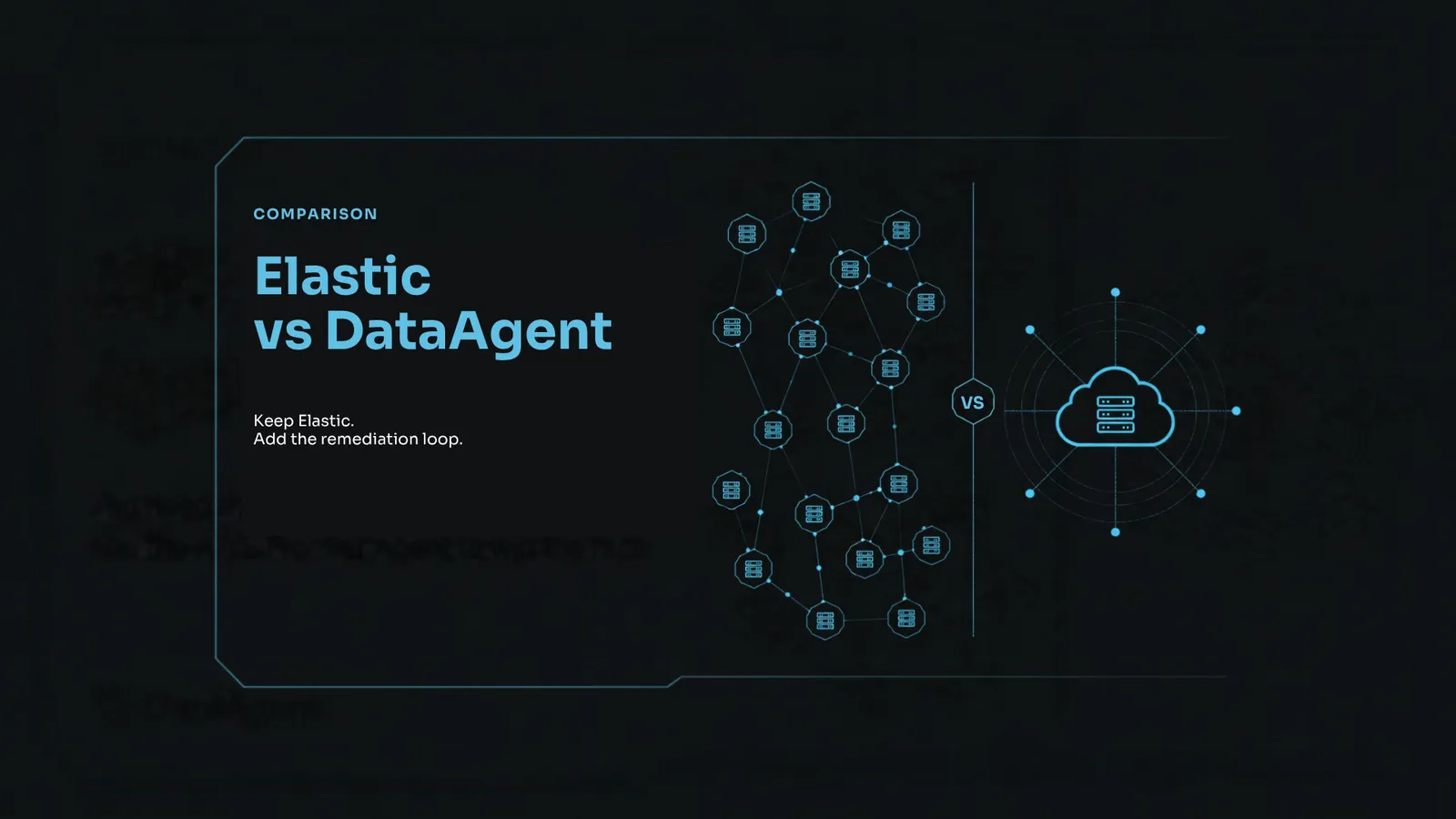
Quick answer: Elastic isn't a head-on rival the way some observability vendors are, it's the search, security, and log-storage platform underneath a lot of Kubernetes stacks, and DataAgent is built to read it in place rather than replace it. Elastic owns search (ES|QL, vector), SIEM (Attack Discovery), and the log datastore, and none of that is DataAgent's fight. What DataAgent adds is the autonomous K8s and cloud SRE loop on top: PULSE detects, TIDE enriches with live topology, SURGE diagnoses, STEER gates the fix against autonomy a fault class has earned (the Fault Ladder), RAPS executes it, and WAKE learns from the verified outcome. DataAgent, an autonomous SRE platform, reads Elasticsearch itself in place as a signal source, no data migration required, and its optimizer can help right-size the Elasticsearch storage bill in the process, since Elasticsearch is a storage-heavy platform. Autonomous action is something you enable, after a read-only deployment shows which fault classes DataAgent can detect, understand and remediate in your environment.
Elastic earns real credit here. ES|QL and vector search are best-in-class, Elastic Security's Attack Discovery is built to speed up threat investigation, and Elastic's AIOps (anomaly detection, log categorization) is mature and needs little to no manual configuration. Elastic Workflows, GA as of release 9.4, is a real automation engine, not a vague roadmap item. This isn't a "replace Elastic" pitch. It's a "keep Elastic for what it's genuinely best at, and add the autonomous remediation loop it doesn't have" pitch.
Architecture
The architecture question with Elastic is a little different than with a pure observability vendor: Elastic is both a universal ingester and a datastore, so the question is whether RCA and remediation require centralizing your data into Elasticsearch first, or can run against your live systems directly.
How Elastic handles it
Elastic's RCA breadth comes from centralizing logs, metrics, traces, and security events into Elasticsearch, a resource- and storage-priced store. Because Elasticsearch is also a general-purpose search and analytics engine, the incentive to collect broadly, "just in case" a query or a threat hunt needs it, is especially strong. That's a real strength for search and security use cases, and a real cost driver for observability ones.
How DataAgent handles it
DataAgent's agents run inside your clusters and read Kubernetes and AWS control-plane state directly, at the source, without requiring anything to be centralized first. This is the same federated, read-in-place model DataAgent applies everywhere, and it extends to Elasticsearch itself: DataAgent reads your existing ES data as a signal source through the ES|QL API and the Elastic MCP Server, and never asks you to move it. Fidelity stays lean by default and rises to full resolution exactly where and when a fault is unfolding, rather than being retained broadly in advance.
Cost Model & the Elasticsearch Storage Bill
This is where DataAgent's value to an Elastic user is most concrete, and it's worth leading with, since Elasticsearch's storage appetite is well known across the industry.
How Elastic handles it
Elastic Cloud is resource, storage, and ingest priced, and Elasticsearch is storage-heavy: primary plus replica shards, hot-tier retention, and the compute needed to keep it all queryable. Elastic gives you real levers to manage that yourself: Index Lifecycle Management (ILM), hot/warm/cold/frozen data tiers, searchable snapshots, and shard right-sizing. Those levers work, but someone on your team has to design and maintain the policy, and the underlying business model still bills you for the resource footprint of what you keep.
How DataAgent handles it
DataAgent's optimizer applies the same kind of levers, ILM, data tiers, searchable snapshots, shard and replica right-sizing, automatically and incident-aware: full fidelity and hot-tier treatment for services in an active incident, tiered down and trimmed in steady state. Because DataAgent's cost model isn't tied to your Elasticsearch footprint, it has a direct incentive to shrink your ES bill instead of growing it, right-sizing the resource footprint your team would otherwise have to manage by hand.
MTTR Reduction
Diagnosis speed and fix speed both roll up into the number leadership tracks, mean time to resolution, and it's worth separating the two.
How Elastic handles it
Elastic's AIOps (anomaly detection, log spike detection, log pattern categorization) and AI Agent genuinely cut diagnosis time, no manual thresholds, unsupervised models that adapt to changing traffic, and a generative assistant that can explain what happened. That's real value on the diagnosis half of MTTR. The fix half runs through Elastic Workflows, which is real automation, but something your team authors, and as of 9.5 can gate with an experimental human-approval step.
How DataAgent handles it
DataAgent decouples stabilization from full root-cause analysis. A fast, deterministic circuit-breaker fires in seconds to stabilize a proven fault class while SURGE's deeper root-cause analysis keeps running in the background, so time-to-mitigate isn't waiting on a complete diagnosis or a person authoring and running a workflow. This is the remediation-first approach: fix first, investigate later.
Remediation & the Autonomy Model
This is the core differentiator, and it's the same one that shows up across every serious competitor in this space: whether the platform's act step is something a person builds and authorizes, or something that's earned trust through proof.
How Elastic handles it
Elastic Workflows, GA as of release 9.4, is real: an automation engine built into the platform, running directly against your Elasticsearch data, authored in YAML and, as of 9.5, by describing what you want in natural language (the Elastic AI Agent writes the workflow for you to review and run). It can call external APIs and connectors, and 9.5 added versioning with one-click rollback to a prior workflow version. For steps that shouldn't run unattended, 9.5 also added waitForApproval (experimental), which pauses the workflow for a person to approve or reject, in the tool or in Slack. Elastic describes extending workflows toward Kubernetes remediation as future work. That's a genuinely capable automation platform. It's also, by design, something your team writes and decides to trust, workflow by workflow, not autonomy that's been proven against a defined set of failure scenarios before it's granted broadly.
How DataAgent handles it
DataAgent runs a closed loop: PULSE detects, TIDE enriches with topology and drift evidence, SURGE produces the root-cause chain-of-thought, STEER gates the proposed fix against trust thresholds earned per fault class (the Fault Ladder), RAPS executes the verified playbook, and WAKE learns from the confirmed outcome. The difference from workflow automation isn't the presence of a gate, both platforms gate action, it's what earns the gate: DataAgent proves a fault class against an injected, answer-keyed failure in a sandbox before granting it autonomy broadly, rather than a team writing and reviewing one workflow at a time. A fault class that hasn't earned that proof yet still routes to a human, and autonomous action is enabled by the customer, not assumed.
Copilot vs. Autonomous Remediation
Separate from whether a fix is possible at all is the interaction model: does a person have to read an AI-generated suggestion and decide to run it, or does the system act directly for what it's already proven it can handle.
How Elastic handles it
Elastic's AI Agent (which replaced the AI Assistant for Observability as of 9.4) investigates, explains, and can call Elasticsearch APIs and Kibana connectors on your behalf, but it doesn't run a proven, autonomous K8s remediation loop. Agent Builder, GA since 9.4, is a general-purpose agent framework rather than K8s or cloud SRE remediation, and its path to action is review-and-run: the AI Agent writes a workflow, a person reviews it, then it runs.
How DataAgent handles it
There's no chat window sitting between detection and the fix by default. Once a fault class has proven itself through sandbox fault injection and the customer has enabled autonomous action for it, STEER lets DataAgent act on it directly in production, without waiting for someone to read a suggestion and click run, and it still routes anything unproven to a human instead of guessing.
Cloud Control-Plane RCA
Some of the most common causes of outages never show up as a clean application metric: a revoked IAM permission, a denied RBAC request, a config change nobody flagged.
How Elastic handles it
Elastic is a strong cloud-log ingester, its SIEM ingests CloudTrail and gives real visibility for security investigation and Attack Discovery. That's a genuine strength, don't let anyone tell you Elastic can't see the cloud control plane. What it doesn't do is run an autonomous SRE loop on that data: CloudTrail visibility lives in the SIEM/security context, correlated for threat hunting and case response, not wired into an SRE remediation loop that diagnoses and fixes an infrastructure fault from it.
How DataAgent handles it
DataAgent reads CloudTrail, IAM, and the Kubernetes audit log directly, as part of the same loop that diagnoses and fixes a fault, not a separate security-context ingestion path. That's what lets it attribute causes like a silently revoked IAM permission or an RBAC denial back to the exact change and actor, and carry that attribution straight into a gated, verified fix.
Alert Noise & Incident Grouping
A platform that surfaces every anomaly as its own alert creates its own kind of toil, a dozen pages for the same root cause instead of one page that says what actually broke.
How Elastic handles it
Elastic's machine learning here is genuinely mature and needs little to no manual configuration: anomaly detection continuously models normal behavior and flags deviations without hand-set thresholds, and log categorization automatically groups related log events by message pattern so you're not scanning duplicates one by one. This is real, production-proven noise reduction on the data Elastic already holds.
How DataAgent handles it
Incidents are grouped by topology proximity, not just metric or log-pattern correlation. A database issue and the five downstream services it's affecting collapse into one incident automatically, because the grouping is based on the live dependency graph TIDE maintains, which reflects what's actually connected to what right now, not a pattern learned from historical log text.
Extensibility & Agent-to-Agent Composability
Both platforms are MCP-native, which opens a genuinely useful integration path that doesn't exist with most competitors, worth calling out on its own.
How Elastic handles it
Elastic Workflows and Agent Builder give teams a real extensibility surface: new connectors, event triggers, and tools a team can wire together. Elastic also ships a generally available MCP server through Agent Builder and MCP Apps (public preview, April 2026), and Workflows can call external APIs, which opens a path to call DataAgent from a workflow.
How DataAgent handles it
DataAgent's fault-class catalog extends through WEAVE (declarative fault-class definitions) plus K8sGPT-style analyzers, with every class earning its way into production through sandbox fault injection before the Fault Ladder trusts it with production faults. Because DataAgent is also MCP-native, the two platforms compose cleanly: Elastic Workflows can invoke DataAgent as the K8s/cloud remediation step, and DataAgent can read Elastic through its MCP Server, each platform doing the part it's actually built for.
Fault Coverage, Side by Side
Depth key: ● full loop, autonomy earned per fault class · ◑ detect + RCA + workflow-authored or guided action · ○ detects or investigates only · n/a not covered
| Capability | DataAgent | Elastic |
|---|---|---|
| Search / log analytics at scale | n/a, not DataAgent's product | ● core strength, uncontested |
| Security / SIEM (Attack Discovery, case response) | n/a, not DataAgent's product | ● core strength |
| K8s/app symptom detection (crash, OOM, latency, errors) | ● | ● mature ML anomaly detection and AIOps |
| K8s/app autonomous remediation | ● earned per fault class (Fault Ladder) | ◑ Elastic Workflows (GA 9.4): team-authored automation calling APIs and connectors; approval step experimental in 9.5; K8s remediation on Elastic's roadmap |
| Config drift / RBAC denial / policy denial (audit-attributed) | ● | ◑ ingests K8s audit for correlation; action happens via a workflow you build |
| Cloud control-plane RCA (CloudTrail / IAM) | ● federated, read in place, wired into the fix loop | ◑ strong visibility via SIEM ingest; centralized and resource-priced, not wired into autonomous SRE remediation |
| Cost model | processes data inside your environment, focused on Golden Metrics | resource / storage / ingest-priced, ES is storage-heavy |
| Extensibility | fault-class extension (WEAVE) + K8sGPT, proof-gated | Elastic Workflows + Agent Builder tools, team-authored |
This is a representative comparison based on each vendor's own public documentation, not the full picture on either side, and Elastic ships fast, worth re-checking Workflows' K8s/cloud coverage depth as it matures past 9.5. Our team is happy to walk through your specific stack on a call.
Running Elastic Already? Here's What Changes
This is the more common starting point than a clean-slate evaluation, since a large share of Kubernetes logs already live in an ELK or EFK stack. Nothing about that setup needs to change to add DataAgent. DataAgent reads your existing Elasticsearch data in place through ES|QL and the Elastic MCP Server, no re-platforming, no write access required to get started, and no data movement. The read-only deployment produces a fault-coverage report and a cost-savings analysis before DataAgent is given permission to act. From there it adds the autonomous K8s and cloud SRE loop Elastic Workflows doesn't provide out of the box, cloud-control-plane RCA wired directly into a verified fix, and an optimizer that applies ILM, data tiers, and searchable snapshots automatically, incident-aware, to right-size the ES storage bill your team would otherwise be managing by hand. Elastic Workflows can also call DataAgent directly as the K8s/cloud remediation step for teams that want to keep Workflows as their system of record.
Who This Matters Most For
Mid-market SRE and platform teams (roughly 16 to 50 engineers) already running Elasticsearch as their log backend get the most immediate win: DataAgent adds the remediation loop without touching the existing ELK/EFK investment, and the ES storage optimization adds a cost lever on top.
Larger, lower-enterprise platform orgs (50-plus engineers) are the ones actually paying for Elasticsearch's storage appetite at scale, and the ones most likely to need auditable, gated automation rather than a workflow one engineer wrote and everyone trusts by default. The Fault Ladder's earned-autonomy model, proof before broad trust, is built for exactly that review.
High deploy-velocity teams of any size feel the gap Elastic Workflows leaves: authoring and reviewing a new workflow for every emerging failure mode doesn't scale at ten-plus deploys a day, tracing an incident back to the specific change does.
Where It Lands
Elastic is genuinely excellent at what it's built for: search, security, and being the datastore a lot of Kubernetes logging already runs on. That's not DataAgent's fight, and this isn't a pitch to replace it. What Elastic doesn't have is an autonomous K8s and cloud SRE loop: its RCA depends on centralizing data into a resource-priced store, its act step is a workflow your team authors and reviews, and its cloud-log visibility lives in a security context rather than an SRE remediation one. DataAgent, an autonomous SRE platform, reads that same Elasticsearch data in place, adds PULSE-TIDE-SURGE-STEER-RAPS-WAKE as the loop Elastic doesn't have, proves each fault class before trusting it broadly, and helps right-size the Elasticsearch bill along the way.
Don't just observe. Remediate.
Sources (verified October 2026)
- Elastic Workflows: GA in 9.4; natural-language authoring, versioning and approval steps added in 9.5
- Elastic AI Assistant for Observability documentation
- AI Assistant for Security / Agent Builder documentation
- Elastic MCP Apps announcement (April 2026)
- Agentic Kubernetes investigations with Elastic and MCP
- Elastic AIOps overview
- Root cause analysis with logs: Elastic Observability's anomaly detection and log categorization
- Protect your AWS workloads using Elastic Security (CloudTrail ingestion into the SIEM)
- Elastic Kubernetes audit logs integration
- Elastic data tiers, ILM and searchable snapshots documentation
- Elastic MCP server and Agent Builder tools (GA)
This comparison is based on Elastic's publicly documented product capabilities as of the dates above. Elastic ships quickly, if something here is out of date, we'd genuinely like to know, flag it to the DataAgent team.
- #Elastic
- #Comparison
- #Autonomous SRE
- #Remediation
- #Elasticsearch
See remediation-first in your own stack
Install an agent and watch DataAgent map your topology. No credentials, no commitment.
Keep reading
 Engineering7 min
What You Won’t Hear at ObservabilityCON
The stage shows an AI agent on top of your data cloud. The people who carry the pager, when no vendor is in the room, describe something else: an agent that goes to the data, a backend that becomes storage, and a bill that stops charging for a reader who has left.
Nati Shalom • Oct 15, 2026 Engineering14 min
Who Pays for the Dashboard?
We priced one Kubernetes-on-AWS workload across observability backends. Copying telemetry into a SaaS platform costs 5–9× the open-source floor, and an autonomous agent uses none of what the premium buys. Build the substrate cheap; fund the loop.
Nati Shalom • Oct 11, 2026 Engineering11 min
Is AI Making Your SRE Team Better? Ask the Scale, Not the Mirror
AI makes engineers faster at producing changes and makes production less stable. Which effect wins depends on your platform. Four production numbers tell you whether AI is actually making your SRE team better.
Shahar Harap • Oct 11, 2026