Jev Named the Layer. Now Somebody Has to Measure It.
A model that only makes decisions is the right idea for autonomous operations. But the number that autonomous action depends on is still unmeasured, by the vendor, by the press, and by the first paper built on it.
 Nati ShalomCo-founder & CTO
A model that only makes decisions is the right idea for autonomous operations. But the number that autonomous action depends on is still unmeasured, by the vendor, by the press, and by the first paper built on it.
On September 15, 2026, a company called TypeSafe shipped a model that cannot write a sentence.
Here is what it does instead. You hand Jev some context plus a set of questions whose answers are fixed in advance. It returns an answer to each one with a probability attached. There are three kinds of question: pick from a list, place something on a scale, or answer yes or no. TypeSafe calls this a System One model, after Kahneman’s split between fast gut judgment and slow deliberate thought.
No chat, no code, no prose at any point. If you want the full walkthrough before going further, the Ultimate Guide to Jev covers the mechanics and 8 Cool Things People Use the Jev Model For covers what people are building with it.
It sat at the top of Hacker News all day, which almost never happens for a startup launch, and drew more than 475 comments.
The comments are more interesting than the launch. Three different people asked the same question in them. Nobody answered it.
If it says 91% but is right 75% of the time, what happens to the code that trusted the 91%?
Most of an agent’s work is not writing
Watch what an agent does during an incident. The surprise is how little of it is language.
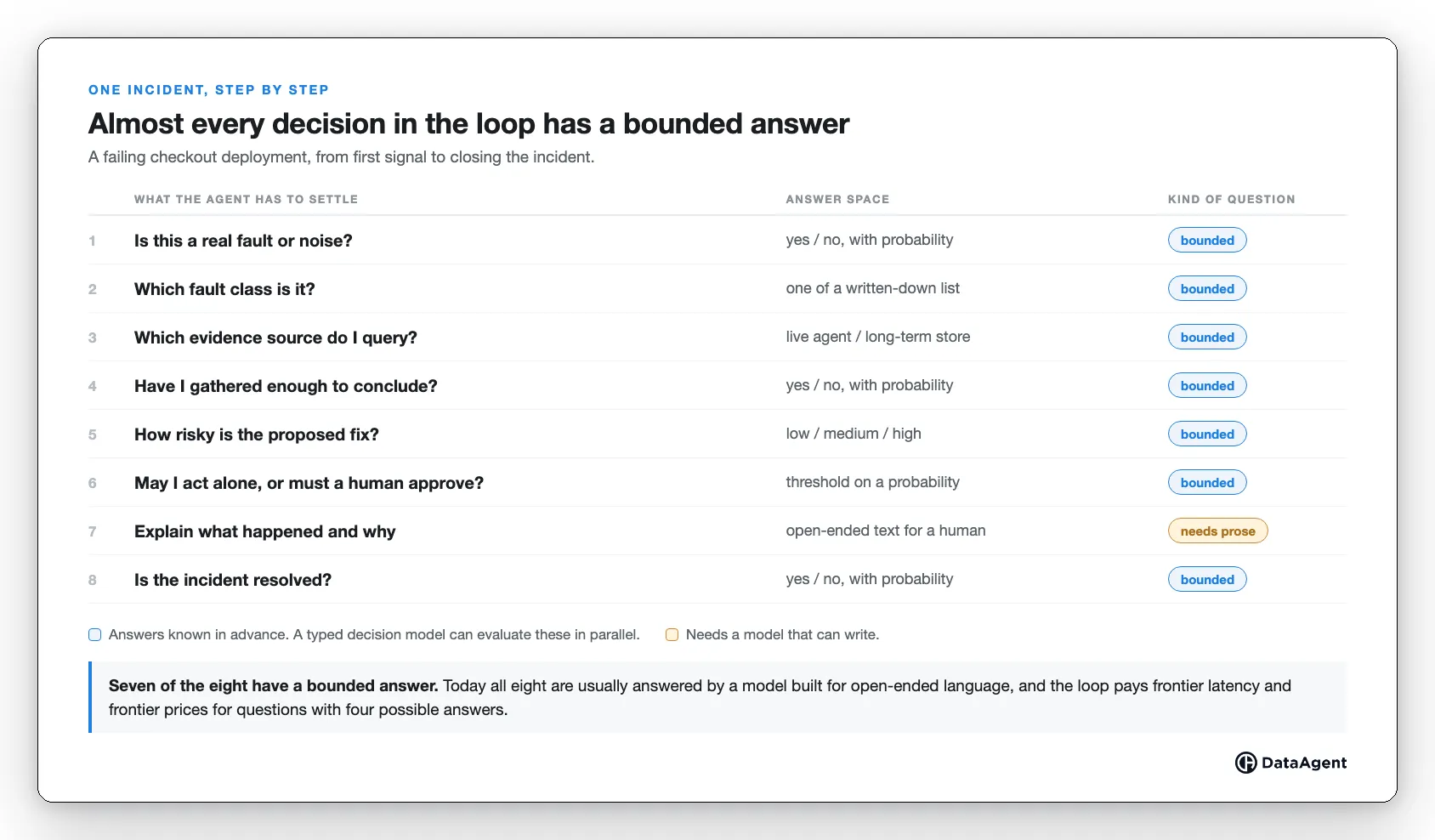
Otto, our agent, picks up a failing deployment. Before it writes anything a human will read, it settles a run of small questions. Is this real or noise. Which fault class is it, meaning which known failure shape it matches. Is the fix risky. Is it over.
Every one of those has a bounded answer. None needs a model that can write free-form English. All of them get one anyway, because until recently that was the only tool in the building.
That is not a rounding error in the bill. An agent re-sends its whole context on every step, tool call and retry. Most of the traffic is the agent talking to itself. The expensive part of an incident is not the write-up. It is everything the agent settled before it could start writing.
An agent’s expensive habit is asking a model that can write anything to answer a question with four possible answers.
What Jev actually is, stated carefully
The three question types have names worth knowing, because they are what you design against. Choice picks from known options. Score places the input on an ordered scale. Noul answers a yes or no and gives the probability that it is true. The model scores them all in one pass rather than one token at a time, so asking eight questions costs roughly what asking one costs.
The real numbers are smaller than the ones going around. TypeSafe quotes peaks of 193.6 times faster and 444.6 times cheaper. It also says plainly that those are the high end. Independent testers land at roughly 5 to 25 times, depending on what they compare against. Input costs $0.042 per million tokens and output is free. Latency of 70 to 500 milliseconds is holding up in outside tests.
Two things deserve more attention than they got.
The first is that it is not new. Within hours, engineers on Hacker News had matched Jev to encoder classifiers, zero-shot span models, constrained decoding and conformal prediction. Someone asked the founder straight out whether this was basically a zero-shot classifier. He replied “exactly right!”
The second is that it is not more accurate. On TypeSafe’s own dashboard, Jev scores 67.8% where Claude Opus 5 scores 73.1%. Cheaper, faster, and a little worse.
So the launch was a naming event more than a technology event. That sounds like a criticism. It is not. Naming is how a pattern people were hand-rolling becomes a layer they can design against.
The first real evidence is not from the vendor
Six days after the launch, researchers at UT Dallas published Jev-Mem. It splits an agent in two. A control plane makes fast typed decisions. A reasoning plane is kept for actual thinking.
Read it closely and it tests the shape, not the product. Its only mention of TypeSafe calls Jev “one concrete realization of the System-One controller.” It never says it called the Jev API, and it never names the model doing the control work. The reasoning model was gpt-4o-mini. There is no funding from TypeSafe and no stated relationship, so it is genuinely independent. It is also evidence for the split rather than for Jev, which is worth holding onto.
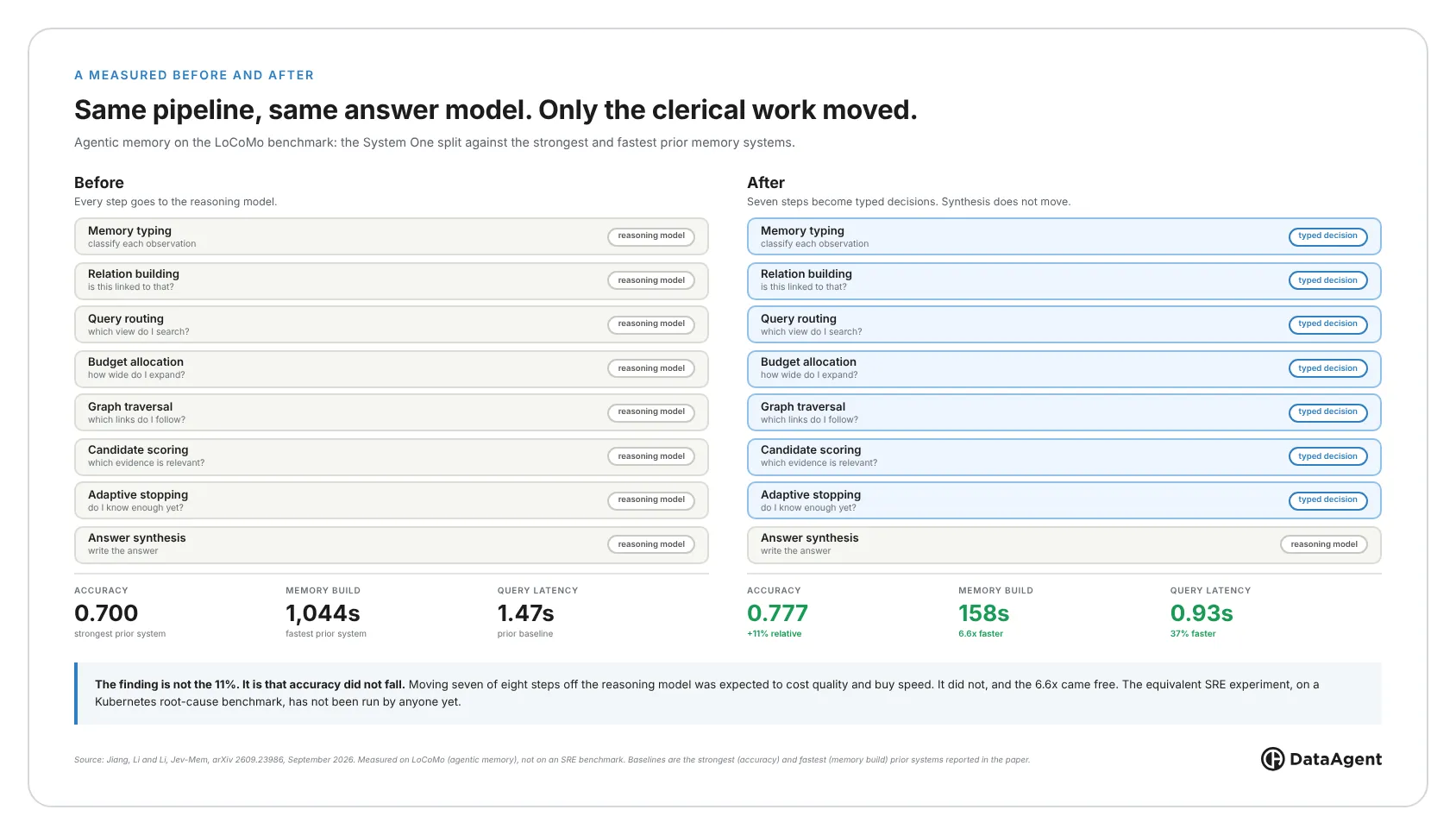
What strikes you is how ordinary the offloaded jobs are. Sorting an observation into a type. Judging whether two memories relate. Working out which way a causal link points. Picking which view to search, how much effort it gets, and whether enough has been seen. The abstract lists seven controller functions in all, with answer synthesis as the eighth step. None of the seven needs a sentence written. All of them used to go to a model built to write sentences.
Their stopping rule is worth quoting, because it makes the argument concrete. Retrieval halts when the evidence scores 0.95 or better for sufficiency, missing evidence is under 0.15, and contradiction is under 0.15. Or it halts when the chance another round helps drops under 0.15.
That is four thresholds on four probabilities. The agent’s sense of when it knows enough is not reasoning in any deep way. It is arithmetic on numbers a model produced. That is exactly the shape of an autonomy gate, which is why the honesty of those numbers matters so much. Worth noting: the authors did not trust them on their own either. They wrapped them in hard limits of eight levels, sixty nodes, sixteen calls, fifteen seconds.
On LoCoMo overall it reached 0.777 against the best baseline at 0.700, while memory construction took 158 seconds against 1,044 for the fastest competing memory system, and query latency fell from 1.47 to 0.93 seconds. The overall number hides the more useful finding. The gain is not spread evenly.
| Category | Jev-Mem | Best baseline | Change |
|---|---|---|---|
| Adversarial | 0.962 | 0.742 | +29.6% |
| Open-domain | 0.618 | 0.517 | +19.5% |
| Multi-hop | 0.623 | 0.569 | +9.5% |
| Single-hop | 0.802 | 0.776 | +3.4% |
| Temporal | 0.637 | 0.650 | slightly worse |
Almost all of it comes from two places. Adversarial questions, where the job is to reject a convincing distractor. And open-domain questions, where the answer has to be built from several pieces. Simple lookups barely moved. And temporal reasoning, the one category about time and ordering, got slightly worse.
Hold onto that last row. Jev’s own documentation admits weakness on numbers and dates, and here is an independent result landing in the same spot. For incidents that is badly aimed. The biggest gain is telling real evidence from convincing noise, which is most of triage. The loss is working out what happened before what, which is most of a root cause.
Be careful with the 11% too, the relative gain of 0.777 over 0.700. It is one preprint, on one benchmark, scored by a model acting as judge, with nobody else repeating it, and no ablations to say which of the controller’s decisions earned it.
The interesting result is not that accuracy rose. It is that it did not fall. A typed model is less accurate than a frontier model on its own. So you would expect quality to drop when seven of eight steps move off the reasoning model, leaving it only complex reasoning and answer synthesis. That did not happen, and the 6.6x speedup in memory construction (158 seconds against 1,044) came free. You are not replacing the smart model. You are taking its filing away from it.
For operations, none of those numbers is the real argument anyway. Three other things are, and each changes what the architecture can do rather than what it costs. A gate that answers in 200 milliseconds instead of 30 seconds is one you can ask on every step, not once. A fixed set of decisions replays the same way every time, which is how you test a gate before you trust it. And eight independent questions cost about what one costs, so you stop rationing questions.
The number the gate rests on
Here is where operations parts company with everyone else writing about this.
In most software a confidence score is advisory. It tints a badge. It orders a list. It decides whether to show a warning. If it is a little dishonest, the product is a little worse.
In a system that changes production it is not advisory. It is the interlock. An autonomy ladder is the rule that decides which faults an agent may fix alone and which it must hand to a human. That rule is a threshold on a probability. Cross it and a command runs.
So the question from the comments is not academic. And TypeSafe’s own documentation holds the answer nobody connected to it: calibration is group-level, not per-answer.
Weather forecasting got here first. Reliability diagrams came out of meteorology for exactly this reason. When a forecaster says 70% chance of rain, the claim is that across many such days it rains about seven times in ten. That is honest and useful. It is also a claim about a population. It says nothing in particular about tomorrow.
For an umbrella that is plenty. You will be right often enough over a season.
An autonomy gate does not get a season. It gets this incident, at 02:14, once.
At 02:14 a checkout service starts failing. Otto calls it a bad deployment at 91% and rolls back, because 91% clears the bar for that fault class. The rollback changes nothing. The real cause was a neighboring workload eating memory on the same nodes, ever since a config change on Tuesday. Twelve minutes gone, and a rollback in the change log that somebody will have to explain.
The 91% was not a lie. Across a thousand decisions of that shape it may well be right 910 times. It was never a claim about this one. The code that read it treated it as though it were.
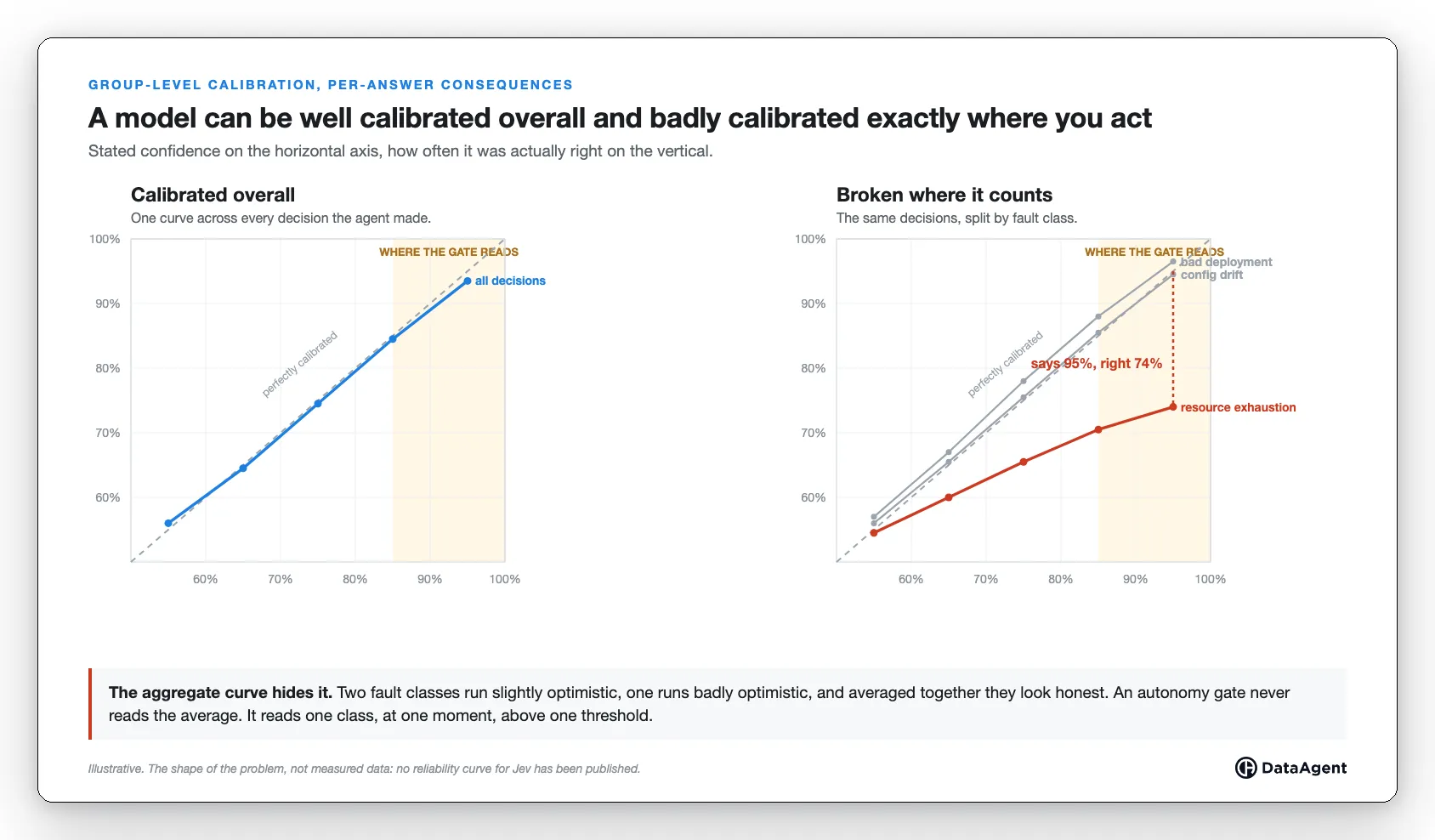
Nobody has published the curve. There is no paper, no reliability diagram, no calibration error figure for Jev. The training method has a name, Reinforcement Learning for Calibrated Decisions, and honest probability is its stated goal. That is the most interesting thing about the model. It is just not a measured claim yet. The first paper built on the idea does not measure it either.
Where it breaks for operations
Three cautions, in the order they will bite.
No rationale. You put in text and get back a float. In operations the audit trail is part of the product, because somebody has to explain why a machine touched production at two in the morning. A calibrated number is something you can threshold on. It is not something you can read. Use the number to gate and a reasoning model to explain. Never let one stand in for the other.
Time and arithmetic. That temporal row is not an accident. Asking whether p95 latency crossed its target is not a question about meaning. (p95 is the response time of your slowest five percent of requests.) Do not hand it to a semantic judge when a comparison operator will do.
The bounded space is the trap. A Choice model cannot return an option outside its schema. That is sold as safety, and for malformed output it is. But the expensive incidents are the new ones. A model that cannot say “none of these” will file a new fault confidently under an old name. Anything that classifies faults needs a route for the unclassified, kept as a candidate new class. It also makes the schema a production artifact with versions. Change it and you have quietly changed every gate that reads it.
The experiment somebody should run
The gap is measurable. Measuring it needs a source of truth about what was actually wrong.
We happen to have one. WEAVE is the internal fault injection harness we use to score our own agent against DataAgent’s published catalog of 35 faults, each with a known answer. Detection and diagnosis are scored against what was really broken, not against an opinion. That makes it a calibration bench. Run the bounded decisions through a typed model, record the probability it gave, compare it to the known answer, and plot the curve. Customer-run injection is not available yet; this is how we measure ourselves.
Two design choices make it worth doing. Draw the curve per fault class, not once overall, because a single global number is the group-level average that hides the problem. And report it where the thresholds actually sit, up in the high-confidence band. That is the only region an autonomy gate ever reads.
There is a second experiment nobody has run. Jev-Mem’s result came from a memory benchmark, where a bad retrieval costs you a worse answer. The same split should be measured on a Kubernetes root-cause benchmark such as ITBench. There, as of May 2026, every frontier model scored below 50%, and a bad decision costs you a change to production. Whether the split still holds when the domain is infrastructure rather than conversation is an open question. It is also a cheap one to answer.
This matters beyond one vendor’s model. Every autonomous system that acts on a confidence score has this gap. It does not matter whether the score comes from Jev, from a frontier model’s self-report, or from a classifier somebody trained in 2019. Benchmarks today measure whether the answer was right. For anything that acts, the second question is whether the system knew how likely it was to be right. Almost nobody measures that. When the answer is wrong half the time, knowing when to stop is not a refinement. It is the safety story.
The verdict
Worth it. With two conditions, and a first step that costs almost nothing.
Do the split even if you adopt nothing. Walk your agent loop and mark every model call whose answer space is bounded. That is an afternoon of work. At the end you know what share of your latency and your bill goes on questions with four possible answers. That number is the whole business case, and it belongs to you rather than to any vendor.
Then put typed decisions where being wrong is cheap. Classifying log templates. Removing duplicate signals. Routing a query to the right evidence source. High volume, bounded answers, and nothing touches production if one misfires. Declare a schema, swap the call. A sprint, not a quarter.
Do not put it on the gate yet. That is the tempting one, and the one to hold back. The gate is exactly where unmeasured calibration hurts, and the vendor’s own documentation says the calibration is group-level. Wait for a reliability curve, drawn per fault class, at the threshold you actually use.
And keep the provider swappable. Jev is early access from a company founded in 2024, the one published result behind it tested the architecture rather than the product, and encoder classifiers running next to your agent get you most of the way with nothing leaving your cluster. The pattern is worth adopting. The dependency is not, yet.
One thing is still undone, and it is what the comments asked for on day one. A model that tells you how sure it is has made a promise. A model that only gives answers never made one. Somebody has to check it.
Until then, 91% is a forecast. Treat it like one, and do not let it restart your database.
Convinced the gate is the hard part, but wondering what the loop around it actually looks like? That is exactly why I started a free, open-source training series on how to build your own autonomous SRE: the detect, diagnose, act, verify loop, wired to your own Kubernetes and cloud planes, built up step by step. Start here: How to build your own autonomous SRE (free, open-source training series).
References
The launch and the model
- TypeSafe AI, Introducing System One Models and Jev
- LangChain, Building a harness with Jev
- Hacker News, Introducing System One Models and Jev
Background and use cases
- unicodeveloper, The ultimate guide to Jev: the full walkthrough of how it works
- Jim Clyde Monge, 8 Cool Things People Use the Jev Model For
- Agent Native, Top 10 Jev use cases in agentic apps
Independent analysis
- Simon Willison, Jev introduces a new shape of LLM
- Agentpedia, Jev and System One Models: the claim versus evidence guide
- Tom’s Hardware, TypeSafe AI’s Jev claims 193x faster and 445x cheaper
Research
- Jiang, Li and Li, Jev-Mem: System-One-Controlled Agentic Memory for Efficient AI Agents, arXiv, September 2026
- Jha, Arora and others, ITBench: Evaluating AI Agents across Diverse Real-World IT Automation Tasks, ICML 2025
- IBM Software Innovation Lab and Artificial Analysis, ITBench-AA SRE results, May 2026: every frontier model below 50% across 59 Kubernetes root-cause tasks, best score 47%
- #Jev
- #System One Models
- #Confidence Calibration
- #AI Agents
- #Autonomous Remediation
- #Autonomous SRE
See remediation-first in your own stack
Install an agent and watch DataAgent map your topology. No credentials, no commitment.
Keep reading
 Engineering10 min
Nobody Can Tell You What Observability Really Costs
Every observability vendor bills in a different unit. We priced one fixed Kubernetes workload with each vendor's own model to show the real cost, why the cheapest option changes as you grow, and why the curve doesn't scale.
Nati Shalom • Nov 1, 2026 Engineering13 min
Who Is the Dashboard For?
A self-driving car has no dashboard and more sensors than ever. The same inversion is coming for cloud observability: less data, a sharper picture, and a new answer to multi-cloud.
Nati Shalom • Nov 1, 2026 Engineering7 min
AGNTCon + MCPCon 2026 Recap: Lots of Noise, Little News. And That’s Good News
My takeaways from AGNTCon + MCPCon 2026: agent security dominated, gateways and sandboxes are multiplying, MCP beat A2A on stage, and the real question is no longer whether agents will fix incidents on their own, but how.
Nati Shalom • Oct 26, 2026