Know What Can Break.Know What You Can Fix.
Comprehensive fault coverage across Kubernetes and AWS, from infrastructure failures to the cloud dependencies that traditional monitoring can miss.
Free and read-only: you can do it in an afternoon. There are two modes: describe your stack, with no credentials, no agent and no writes, then a read-only scan.
Illustrative sample
- Fault coverage assessment
- Expired certificatesMay go unnoticedIllustrative sample
- Connection pool exhaustionAssumed to be coveredSingle point of detection failure
- Crash loopsProven through testingOverlapping rules
- DNS failuresAssumed to be coveredDetected
- Revoked permissionsMay go unnoticedDetection gap
- Database failoverProven through testingDetected
Your observability stack may generate thousands of alerts. But how many of the failures that could disrupt your environment would it actually detect? And how many could you resolve?
DataAgent helps teams understand their fault coverage, identify blind spots, and move toward verified, autonomous remediation across Kubernetes and cloud infrastructure.
Alerts Detect Alerts routinely miss
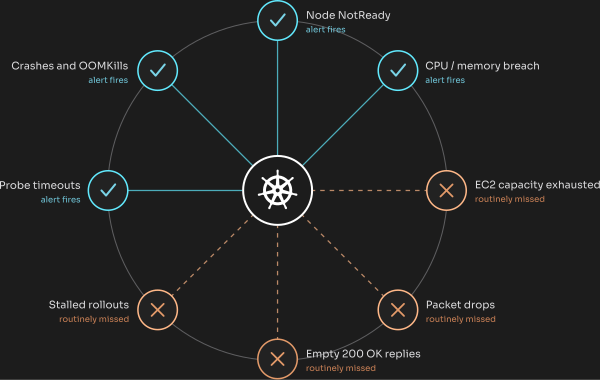
Your Monitoring Stack Has Blind Spots. Do You Know Where?
Modern applications depend on much more than Kubernetes alone. DNS, IAM permissions, security groups, managed databases, storage, networking, and external services can all cause failures that surface as application symptoms.
Yet many teams measure observability by the number of alerts, dashboards, or monitoring rules they have configured, not by the failures those systems can actually detect.
The result? Overlapping alerts for familiar problems, hidden gaps for critical failure modes, and uncertainty about what will happen when something breaks.
Where the alert fires
Kubernetes
HTTP 500sUpstream TimeoutsPods PendingCrashLoopBackOff
Where the failure starts
- DNSCoreDNS upstream throttling
- IAM permissionsIRSA policy narrowed or revoked
- Security groupsEgress to the database cut
- Managed databasesRDS max connections reached
- StorageEBS CSI attach deadlock
- NetworkingCNI IP pool exhausted
- External servicesCloud API throttling
Fault coverage starts with a different question: What can fail in your environment, and would you know if it did?
Beyond Alerts:
Understand Your Actual Fault Coverage
DataAgent approaches fault coverage at the level of the failure itself, not the number of alerts generated.

Identify applicable failures
Map the fault scenarios relevant to your actual Kubernetes and AWS environment.

Analyze what has already happened
Classify historical errors into meaningful fault categories instead of counting every alert as a separate incident.

Expose detection gaps
Compare observed failures with existing alert rules to identify scenarios that may go unnoticed.

Evaluate coverage quality
Identify overlapping detection rules, single points of detection failure, and signals that cannot be reliably classified.

Build toward verified remediation
Establish which failure types are detected, explained, and resolved, and which have been proven through testing rather than assumed to be covered.
What Can Fail in Your Kubernetes and AWS Environment?
3214
scenariosfault classes
DataAgent's fault catalog covers 32 reproducible fault scenarios across 14 fault classes, spanning Kubernetes and cloud infrastructure.
Dependency Failures
- DNS failures
- Blocked network egress
- Security group restrictions
- Database failover
- Unavailable dependencies
Resource Exhaustion
- CPU throttling
- Heap exhaustion
- Connection pool exhaustion
- Autoscaling failures
- Node capacity shortages
IAM and Permission Drift
- Object storage access denied
- Secrets access denied
- Revoked permissions
- Queue access denied
Kubernetes Workload Failures
- Crash loops
- Missing container images
- Failing health probes
- Init container failures
- Unschedulable pods
Storage and Stateful Workloads
- Persistent volume binding failures
- Stateful pods stuck on storage
Service and Network Failures
- Zero ready endpoints
- Network policy blocks
- Poison messages
- Unhealthy load balancer targets
Deployment and Configuration Failures
- Disruption budget issues
- Configuration drift
- RBAC denials
- Expired certificates
The Blind Spot Beyond the Cluster
Kubernetes is only part of the failure surface.
The catalog includes ten cloud-plane fault scenarios, spanning IAM permissions, security groups, managed dependencies, queues, and load balancers.
A cluster-only view may reveal the symptoms without exposing the underlying cloud failure. A service may become unavailable because its database is unreachable, a permission was revoked, or a dependency failed over, not because the Kubernetes workload itself is broken.
Understanding the full failure path means looking beyond the cluster boundary.
Inside the Cluster
App 500 error rate spike
Upstream connection timeout
Pod connection pool timeout
HPA maxed, pods pending

Beyond the Cluster
IAM permissionsCloudTrail AccessDenied event
Security groupsEC2 RevokeSecurityGroupIngress event
Managed databaseRDS DatabaseConnections at max
EC2 capacityKarpenter InsufficientCapacityError
From Possible Failures to Proven Coverage
A monitoring rule is not proof that a failure will be detected. Historical silence is not proof that an environment is healthy.
A meaningful assessment brings together four dimensions:
- 1
What can happen?
Identify the failure scenarios that apply to your infrastructure and dependencies.
- 2
What has happened?
Analyze historical signals to understand which fault classes have already appeared.
- 3
What would be detected?
Compare those failure classes with existing alert rules and detection paths, exposing uncovered scenarios and fragile dependencies.
- 4
What has been proven?
Where testing is available, reproduce known faults and verify that detection, and the relevant remediation path, works as expected.
The goal is not another coverage percentage without context. It is an actionable understanding of what is covered, what is missing, and what still needs to be verified.
Start With Visibility. Progress Toward Autonomous Remediation.
You don't need to begin by replacing your observability stack or giving a new platform control over your environment.
Start by understanding your failure surface and the gaps in your existing detection.
Then establish which failure types can be diagnosed and safely resolved, and where remediation can be verified before greater autonomy is introduced.
Visibility
Know what can break.
Detection gaps
Identify what your stack misses.
Verified remediation
Build confidence in what can be fixed.
How Complete Is Your Fault Coverage?
Get the practical guide to the failure modes that affect Kubernetes and AWS environments, how to assess existing alerting, and how to distinguish claimed coverage from tested coverage.
Learn how to:
 Map the fault scenarios that apply to your environment.
 Identify gaps hidden by overlapping alerts and incomplete detection paths.
 Assess cloud dependencies beyond the Kubernetes boundary.
 Evaluate coverage using evidence and reproducible fault testing.